Gryt on a Phone
A progress report on the Gryt mobile app, six days into building it — what works, what it looks like, and what is nowhere near finished.
Six days
The mobile repository's first commit is dated 20 August. It's 26 August as I write this, and there are 156 commits in it and nineteen builds. The app is a week old, so the screenshots below are a progress report rather than a launch.
It's React Native on Expo, and it draws its interface from the same
@gryt/ui-native package the component library
post covers, which is most of why it
came together this quickly. Sheets, drawers, buttons, sliders and the owl
avatars were already written and already tested on a phone.
What works
Enough to use, which surprised me.
You add a server by pasting its address or opening an invite link, and you can join without an account — the same guest identity the desktop client uses, the same keypair signing the same challenge. Servers you already belong to come with you if you sign in.
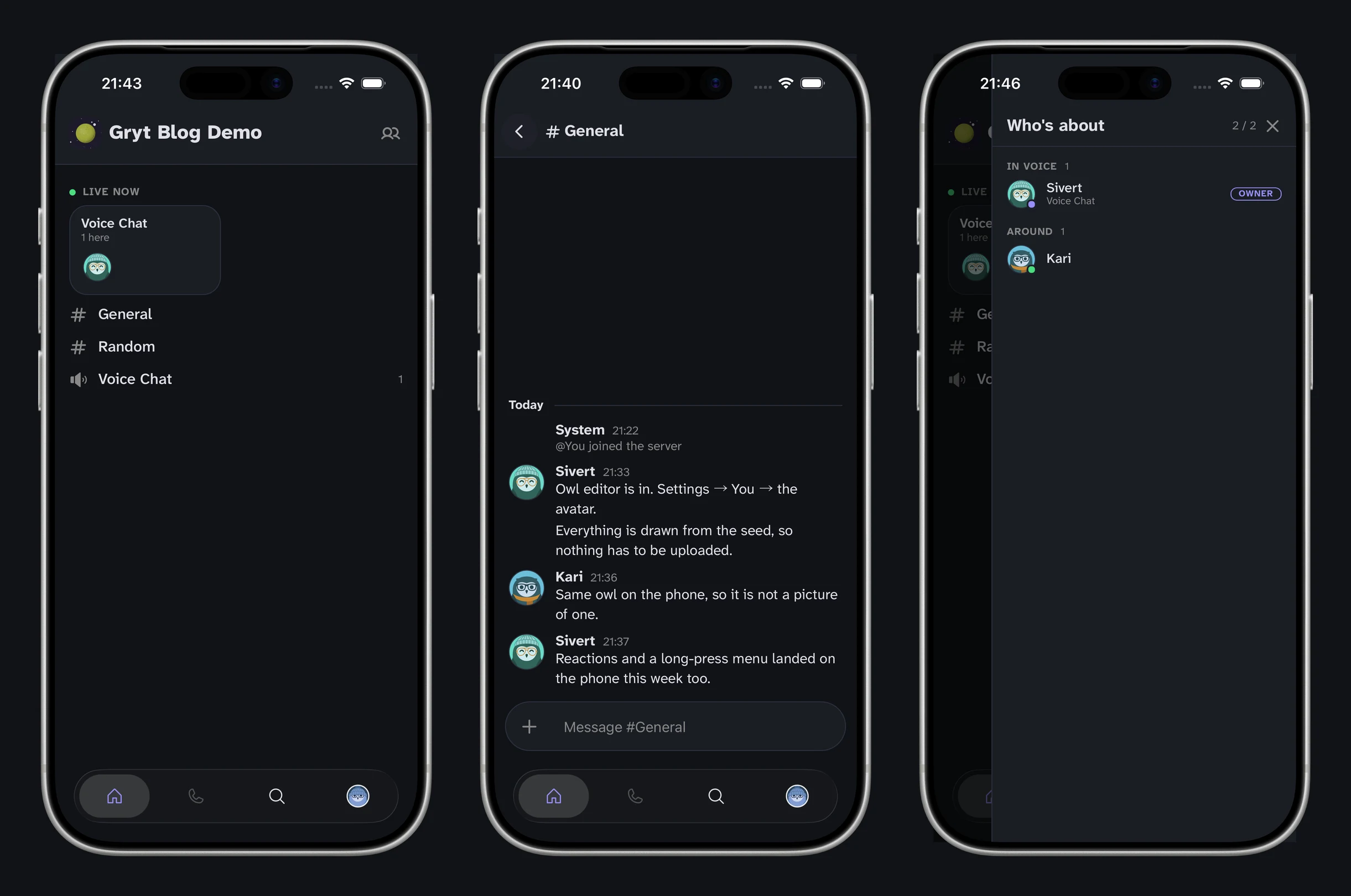
Text is most of the way there. Markdown, emoji, mentions, attachments, a typing
indicator, and a long-press menu on any message with six quick reactions, reply,
copy, edit and delete. Before that landed there was no onLongPress anywhere in
the chat file, so a message could not be touched at all.
Voice works and sounds like voice. Mute and deafen show to the room, there is an audio-route picker that exists on Android as well as iOS, and joining a channel makes a sound so you know it took. Video is in too: your camera, and somebody else's screen. You can also share your own screen from the phone, which took two attempts because the first one crashed on the wrong thread.
The server tab is built around who is actually talking. Rooms with people in them float to the top under a LIVE NOW heading with their faces on them, and the strip isn't drawn at all when nobody is in a call. That occupancy has always been in the payload the server sends; nothing had ever read it.
It's set in Atkinson Hyperlegible
The same face as the rest of Gryt, which took a bit of doing — the font has to
reach the text the component library draws, not only the text the app writes
itself, so @gryt/ui-native's theme learned to carry a font family and both
sides read it from there.
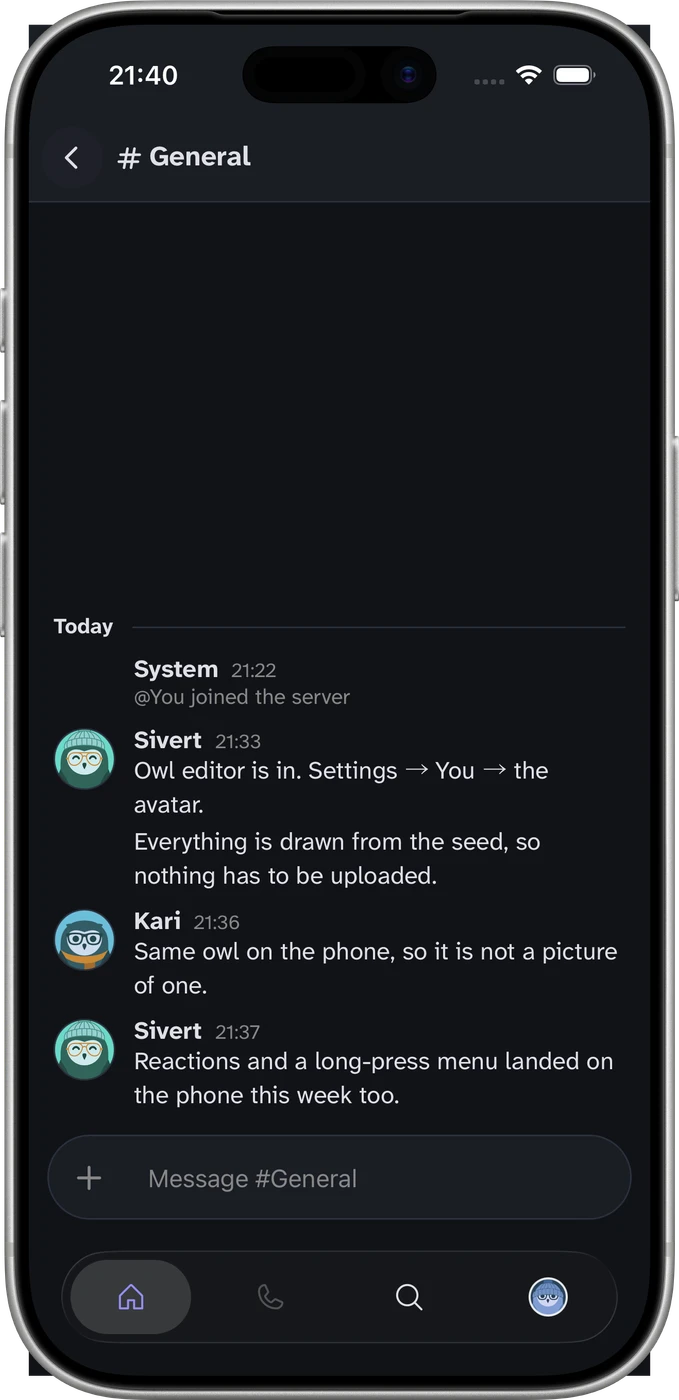
The chat view ships as a setting rather than a decision. Cozy keeps avatars and groups runs of messages from the same person; Compact drops the avatar column and gives the 52 points back to the words. It's stored as an enum rather than a boolean, so a third layout can be added later without migrating anybody.
What doesn't work
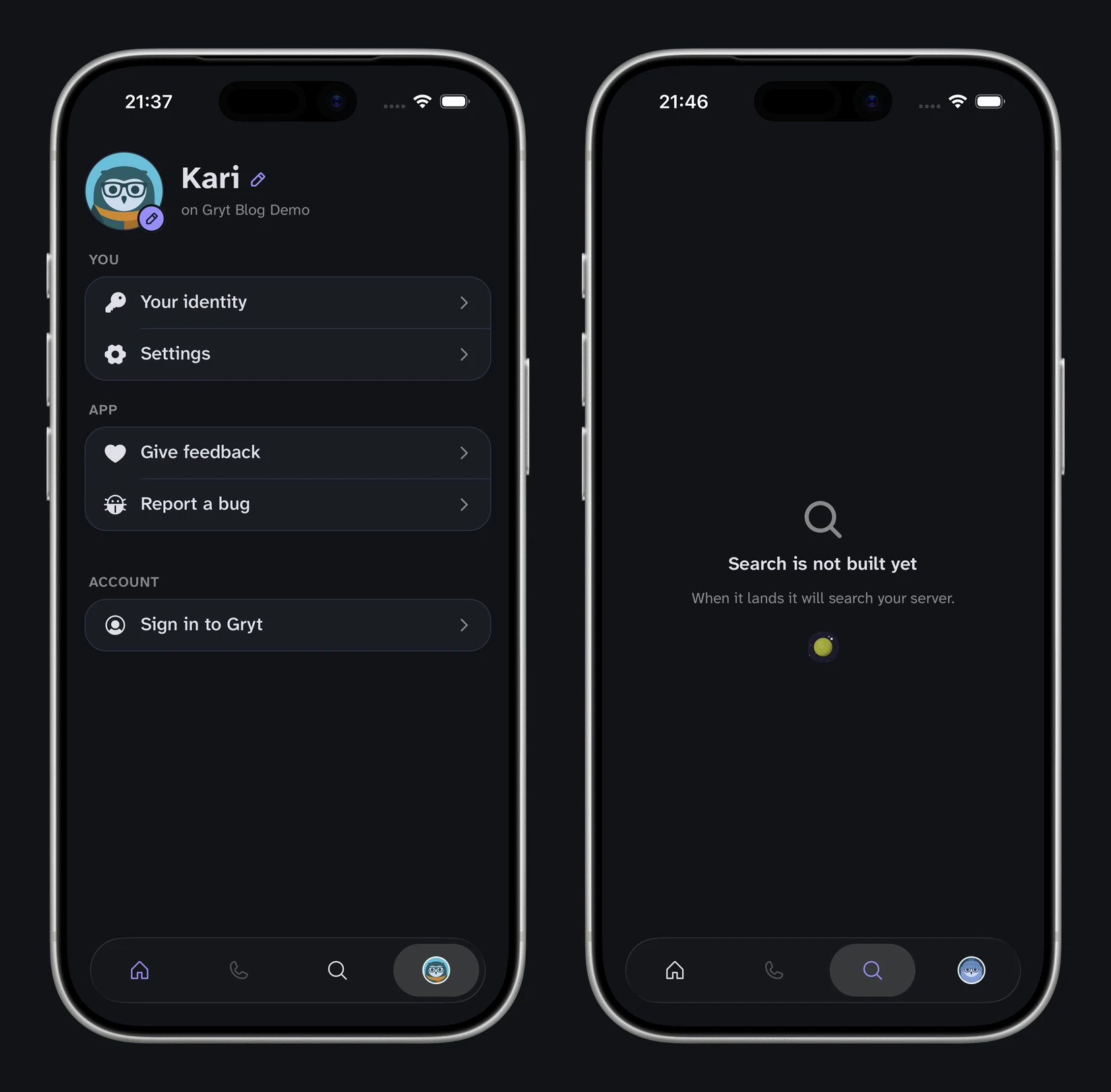
Search isn't built. The tab exists and says so, which I'd rather do than hide the tab and leave people wondering where search went.
There's no App Store listing. Builds go to TestFlight, and getting one requires me to add you. Android builds exist and LAN discovery works there, but Android is behind iOS on polish and has had far less time on real hardware.
The whole thing is version 0.1.0. Things will move.
Why bother
Gryt's argument has always been that the machine under your desk can host the thing you talk on. That argument is easier to make when you're not asking people to be at a desk to answer.
A phone is also the honest test of whether the design system was worth building. If the same theme, the same owls and the same components can render on a completely different renderer and still look like the same product, the split paid for itself. Looking at the screenshots above next to the desktop client, I think it did.
If you want to try it, ask on our Gryt server or Discord, or through feedback.gryt.chat, and I will add you to TestFlight. Bug reports sent from inside the app land in my tracker with the build number attached, which is the one piece of infrastructure I set up before writing any features.