From Concept to Reality
After two years of design iterations and learning, November 2024 marked the moment Gryt became a functional voice communication platform.
The gap between vision and code
For most of 2022 and 2023, Gryt lived in two places: my head and Figma. The designs were detailed, the vision was clear, but the codebase lagged far behind. Every attempt I made at building the actual platform ran into the same wall: I didn't know enough about the underlying technology to make it work properly.
WebRTC isn't something you can duct-tape together. Peer-to-peer audio needs ICE negotiation, DTLS-SRTP encryption, STUN/TURN servers, codec negotiation, jitter buffers, and a signaling layer to orchestrate it all. Every time I tried to shortcut the learning, the result was a demo that worked on localhost and fell apart everywhere else.
So I stepped back. I spent the better part of a year studying WebRTC internals, reading RFCs, experimenting with the Pion library in Go, and building small prototypes that taught me one concept at a time. I wrote about that learning journey in Learning WebRTC From the Ground Up.
All the earlier work, the 2022 proof of concept and the 2023 design iterations, was trial and error. Important trial and error, because every failed attempt taught me what not to do. But it wasn't until late 2024 that everything converged: the design knowledge, the WebRTC understanding, the architecture decisions, and enough free time to actually commit to building it professionally.
November 15, 2024, the first real prototype
On November 15, 2024, I took this screenshot:
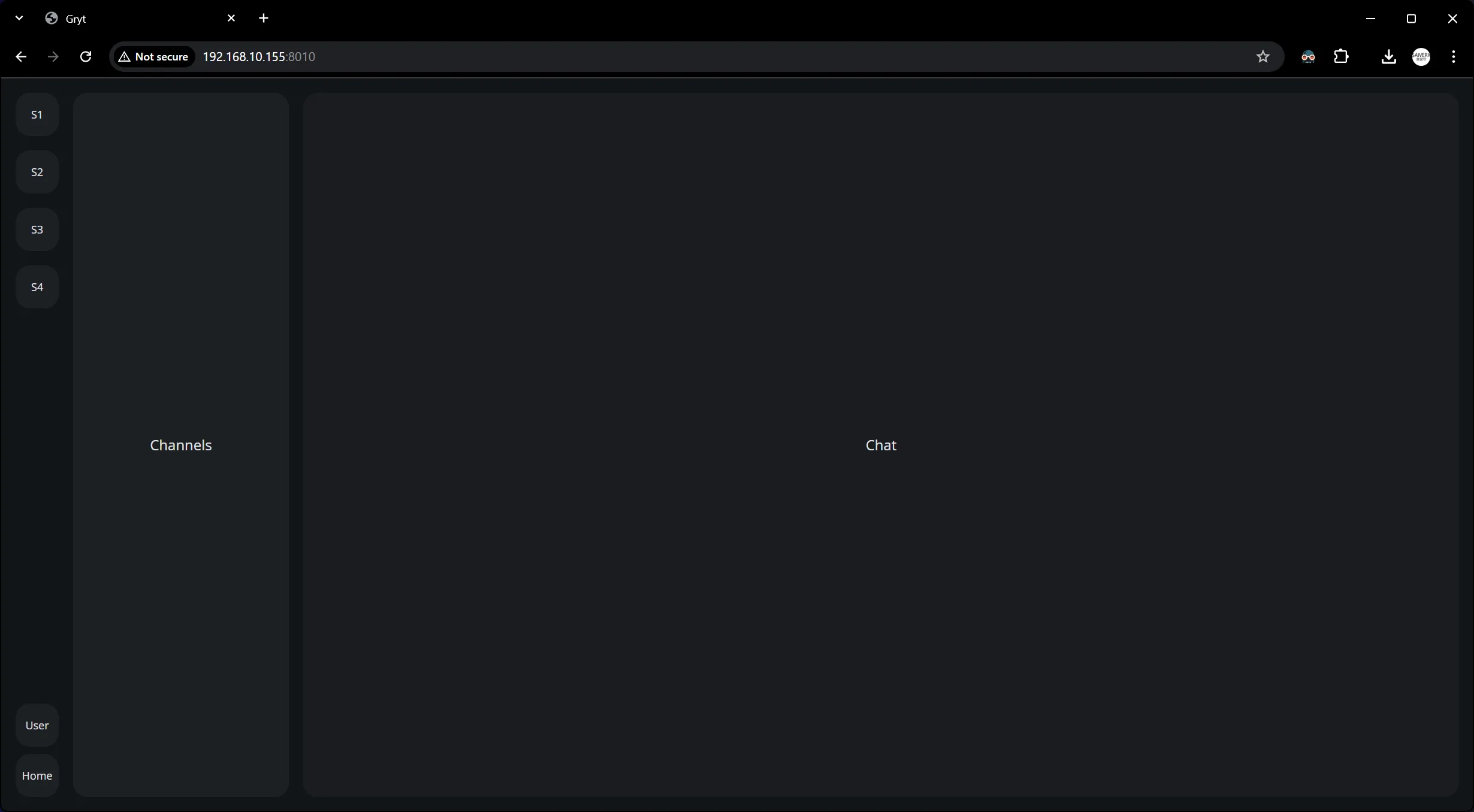
It doesn't look like much. A dark layout with "S1", "S2", "S3", "S4" server icons on the far left, a "Channels" panel, a "Chat" area, and "User" and "Home" buttons at the bottom. Running on a local IP address (192.168.10.155:8010), clearly a development build.
It was the first time the application architecture ran end-to-end: a real React client talking to a real signaling server, with a real authentication flow behind it rather than hardcoded data. Those server icons were actual server objects stored in a database, rendered through proper state management.
Two days later, November 17, 2024
Just two days later, things were already evolving:
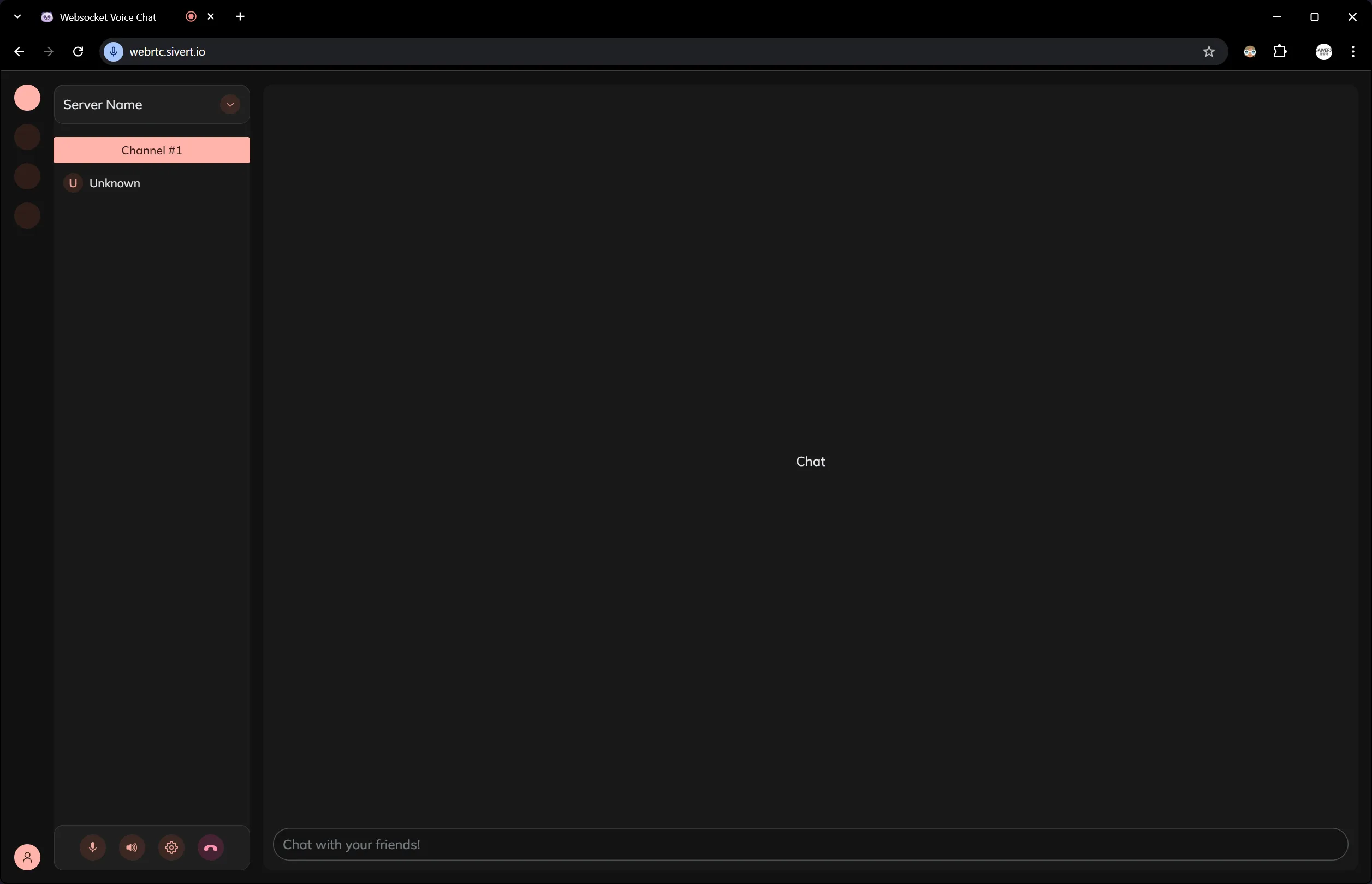
Now it was running at webrtc.sivert.io. The layout had been fleshed out: a server name dropdown, a channel list showing "Channel #1" highlighted in salmon/red, a connected user (named "Unknown", since auth was still being wired up), voice controls at the bottom (microphone, volume, settings, disconnect), and a chat input with "Chat with your friends!" as placeholder text.
The voice controls at the bottom are the key detail here. Those buttons were wired up to actual WebRTC functionality. The microphone button controlled a real audio stream. The disconnect button tore down a real peer connection.
In two days, the app went from a skeleton layout to something that looked and acted like a communication platform.
The first working demo
This video captures the first working demo of Gryt's voice channel system. What you're seeing is multiple users connecting to a voice channel, with the UI updating in real-time: user presence appearing, connection states changing, the whole signaling flow working end-to-end. It's not a recording of actual voice audio, but it represents the proof of concept finally coming together.
The moment I'll never forget, though, isn't in this video. It was sitting at my desk with my laptop open next to my gaming PC, joining the same voice channel from both devices, and hearing my own voice come through the other machine, routed through a Go server I'd written myself. I don't have a recording of that moment, but I remember it vividly. That was when I knew this project was going to ship.
What this video does show is the real-time coordination layer that makes voice possible. To understand why even the channel connection demo was a milestone, you need to know what's happening under the hood:
- Each client establishes a WebSocket connection to the signaling server
- When joining a voice channel, the client creates an
RTCPeerConnectionand generates an SDP offer - That offer is sent through the signaling server to the SFU (written in Go, built on Pion)
- The SFU responds with an SDP answer and begins the ICE connectivity check
- DTLS-SRTP encryption is negotiated between the client and the SFU
- Audio packets flow as encrypted SRTP, routed by the SFU to every other participant in the channel
No peer-to-peer mesh. No direct connections between clients. Everything routes through the SFU, which means:
- Upload bandwidth is constant. Each client sends one audio stream regardless of how many people are in the channel
- The SFU never decrypts the media in forwarding mode. It routes encrypted packets without seeing the content
- Privacy comes from the architecture rather than from a policy
Getting this working was months of debugging ICE failures, DTLS handshake timeouts, SDP format mismatches, and audio pipeline issues. There were days where I'd spend hours tracing a single RTP packet through the system to figure out why audio cut out after exactly 30 seconds. It was an RTCP timeout; the SFU wasn't sending receiver reports.
Everything that came before made this possible
Looking back at the four-year timeline, it's tempting to think the early work was wasted time. The 2022 proof of concept that never went anywhere. The 2023 designs that were too ambitious for the codebase. The months spent reading WebRTC RFCs instead of writing code.
But none of that was wasted. The 2022 proof of concept taught me how authentication flows work in a desktop-web hybrid. The 2023 designs gave me a visual target to build toward, and many of those design decisions, including the channel layout, the profile cards and the role system, survived into the final product. The RFC reading gave me the deep understanding I needed to build an SFU that handles real-world network conditions rather than only localhost demos.
Every iteration shaped the direction. When November 2024 arrived and I finally had the knowledge, the architecture, and the time to build it properly, the pieces fell into place fast because the groundwork had been laid years earlier.
What Gryt is today
Since that first working demo, Gryt has grown into a real platform:
- A React client with real-time noise suppression powered by RNNoise
- A Go-based SFU built on Pion, handling WebRTC media routing
- A Node.js signaling server with Socket.IO for real-time coordination
- Keycloak for authentication and identity management
- Docker Compose deployment for self-hosting
The core principles haven't changed since day one: no paywalls, fully self-hosted, fully transparent, fully focused on security and privacy. They started as lines in a README and they're now decisions baked into every layer of the stack.
This project has been a steady effort since early 2022. Four years of iterations, redesigns, late-night debugging sessions, and slow but relentless progress. It is nowhere near done. It does work, though, and it's open for anyone who wants to use it, contribute to it, or learn from it.
If you want to understand the technical depth behind the WebRTC implementation, read Learning WebRTC From the Ground Up. If you want to try Gryt yourself, check out the GitHub repository, or come chat on our Gryt server or Discord.