From Four Roles to a Permission System
Four hardcoded roles became 41 permissions a channel can change. The hard part was hiding a channel properly.
For most of Gryt's life there were four roles: owner, admin, mod, member. They were
hardcoded, they were a ladder, and what each one could do was written into whichever
handler happened to need to know. If you wanted a role for people who can post but
not join voice, you couldn't have one. If you wanted #rules to be read-only, you
couldn't have that either.
That's gone now. A role is a set of permissions and a rank, both of which you pick, and a channel can change what a role may do inside it.
The checks didn't agree with each other
The rule about who may act on whom was copied by hand into kick, ban, mute and
deafen. Four verbatim copies of the same few lines, and they read the roles table
directly. The gate that had already let the request in read something else, which
also honoured the owner named in the server config. So an owner whose roles row said
admin got past the door and was then refused by the handler, on their own server.
Elsewhere the check wasn't there at all:
- Voice disconnect had no target check, so an admin could pull the owner out of a call.
- Resolving a report with delete-all-and-ban had none either, so the reports panel could ban the owner while the ban handler two files away refused to.
- The member list had no auth check whatsoever. Any socket that had connected could ask for it and get everybody.
All of that was fixed in 1.3.1, in seven passes, and there are tests standing on it now. Two builders were also emitting the member list with the same seventeen fields and disagreeing about five of them, so if you had two clients open, the moderation menu showed "Server mute" or "Remove server mute" depending on which one had answered most recently.
A role is a set of things you may do
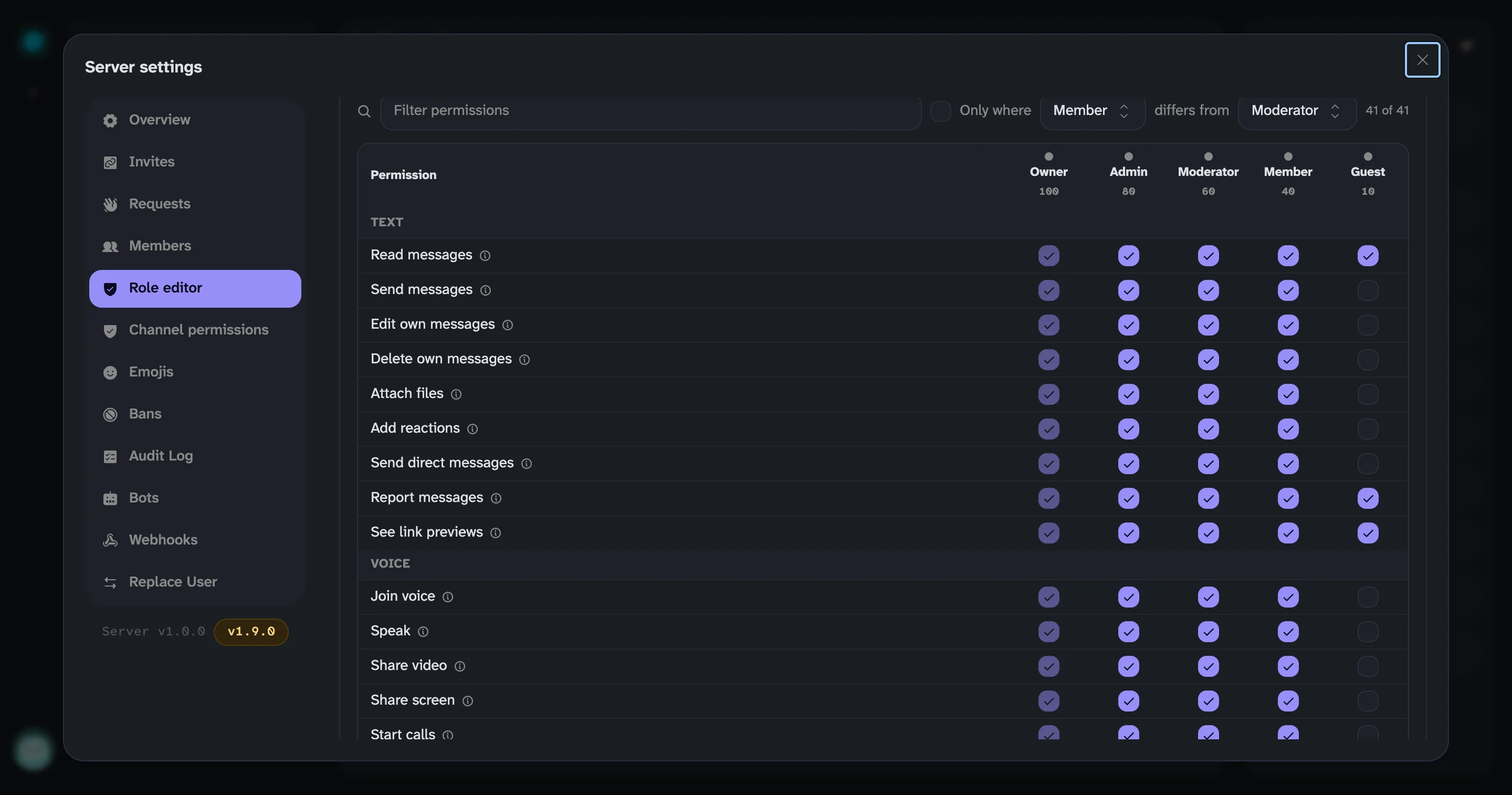
There are 41 permissions. Sending a message is one. Attaching a file is another. Editing your own message is separate from editing somebody else's, deafening is separate from muting, reading the reports queue is separate from acting on what's in it, and starting a call is separate from joining one. That last one is deliberate: gating both would leave somebody unable to answer a call placed to them.
Every role carries two things: that set, and a rank. The permissions say what you can do. The rank says who you can do it to. Keeping them apart is why you can have a role that sits high enough to kick people and holds almost nothing else.
Five roles ship with every server. Owner sits at rank 100, Admin at 80, Moderator at 60, Member at 40 and Guest at 10. They're spaced so a role of your own slots between two of them without renumbering anything. You can rename them, recolour them and change what they hold. You can't delete them, because the defaults and the owner fall back to them.
Four permissions stay out of Admin's set: managing roles, managing the server,
replacing an identity, and answering a bot at the door. An admin who could grant
manage_roles could hand themselves every other permission on the list.
Upgrading a server that already has people on it
Adding a permission to the list doesn't change a single stored role. That's fine until
you add read_messages. Before it existed, anybody admitted to the server could read;
the moment reading is a permission, every role that already exists holds a set that
doesn't contain it. The release that made reading a permission would have left an
entire server unable to read anything.
So each permission records what it was carved out of, or that it had no gate before. On upgrade, a role holding the old one gets the new one, and a permission that had no gate goes to everybody. It only grants. Nothing in that table takes a permission away, so whatever the person running the server has chosen survives an upgrade untouched. Six batches of it so far, and there'll be more.
Read-only channels
#rules is what forced the next step. A public server where anyone can post in the
rules isn't a public server you can launch.
Full per-channel overwrites were the honest fix and they weren't small, so I did the cheap one: a minimum rank to post, as one integer on the channel, checked next to the existing send-messages gate. That shipped in 1.6.17 and it unblocked read-only and staff-only channels without building the model underneath.
The client half arrived a release later, which meant that for a while you could stand
in #rules, see a normal composer, type a message and get told the channel was
read-only for your role. It worked and it wasn't good. The refusal should be visible
before you've typed anything.
Per-channel permissions
1.8.0 replaced that. A channel can now have an opinion about 13 of the 41 permissions: the ones that mean something in one room. Banning somebody means the same thing wherever you're standing, so it isn't on the list.
A rule is allow or deny. There's no third value for inherit, because inherit is the absence of a rule. A channel stores only what it changes, so hiding a channel from three roles is three rows rather than thirteen permissions times every role. It also means a permission I add next year needs no backfill here: every channel that exists already inherits it, which is both the right default and the safe one.
Allow isn't the same as inheriting. It grants a permission the role doesn't hold across the server, which is how one channel lets a role post when it can't post anywhere else.
Hiding a channel properly
Denying read_messages on a channel doesn't grey it out. The server stops naming it.
It's absent from the server details, absent from the sidebar, and asking for it by id
gets the same answer as asking for a channel that was never created.
Getting that right meant finding every path a channel id can travel out on, and the obvious ones weren't the problem. There are thirteen cases in the leak test now. Four of them I missed on the first pass and wrote down as their own task rather than pretend the job was done:
- A webhook row names the channel it posts into, so the webhook list hands over the id of anything hidden.
- An audit entry's target, for a channel action, is a channel id. Reading the audit log is its own permission and can sit on a role well below any channel gate, so somebody at rank 40 could read the id of a channel gated at 80.
- A report snapshots the conversation it came from, so a moderator queue names a hidden channel to whoever is working it.
system_channel_idin the server config, which is one field pointing at a channel that might be gated.
None of those is a channel list. They're all places a channel id ended up as a side effect of something else. Pins, search and mentions join that list the day they exist.
Holding more than one role
Until 1.8.5 the roles table had the member id as its primary key, so holding a second role wasn't representable. Mapping our own Discord's eight roles onto Gryt meant collapsing three of them into one, because they couldn't stack.
You can hold several now. Permissions add up across them and your rank is the highest one you hold. Where two of your roles disagree about a channel, allow wins — picking up a role shouldn't take something away, which is the rule Discord settled on and the one people arrive expecting.
Roles that people earn automatically
A role can ask for a number of days and a number of messages before it grants itself. Set both and both have to be true. Time on its own lands a trusted tier on an account that signed up a month ago and never said a word, which is exactly who you didn't mean.
It only ever promotes. Nothing here takes a role away from anybody.
What the permission system does not cover
Bots don't hold roles at all. A bot knocks, whoever runs the server decides what it may do once, and that's its whole permission set, so no role edit can widen one by accident. What it asked for is written down and never rewritten, because a bot coming back asking for more is asking a question that's already been answered.
Roles are per server, and they always will be. There's no notion of a role that follows you somewhere else.
And none of this is retroactive against somebody who has already read a channel. If a channel was open and you close it, you've stopped them reading it from now on. You haven't unsent anything.
Where to find it in the app
Server settings → Role editor for the roles and what they hold, and Server
settings → Channel permissions for what a single channel changes. Both need
manage_roles, which is owner-only until you decide otherwise.